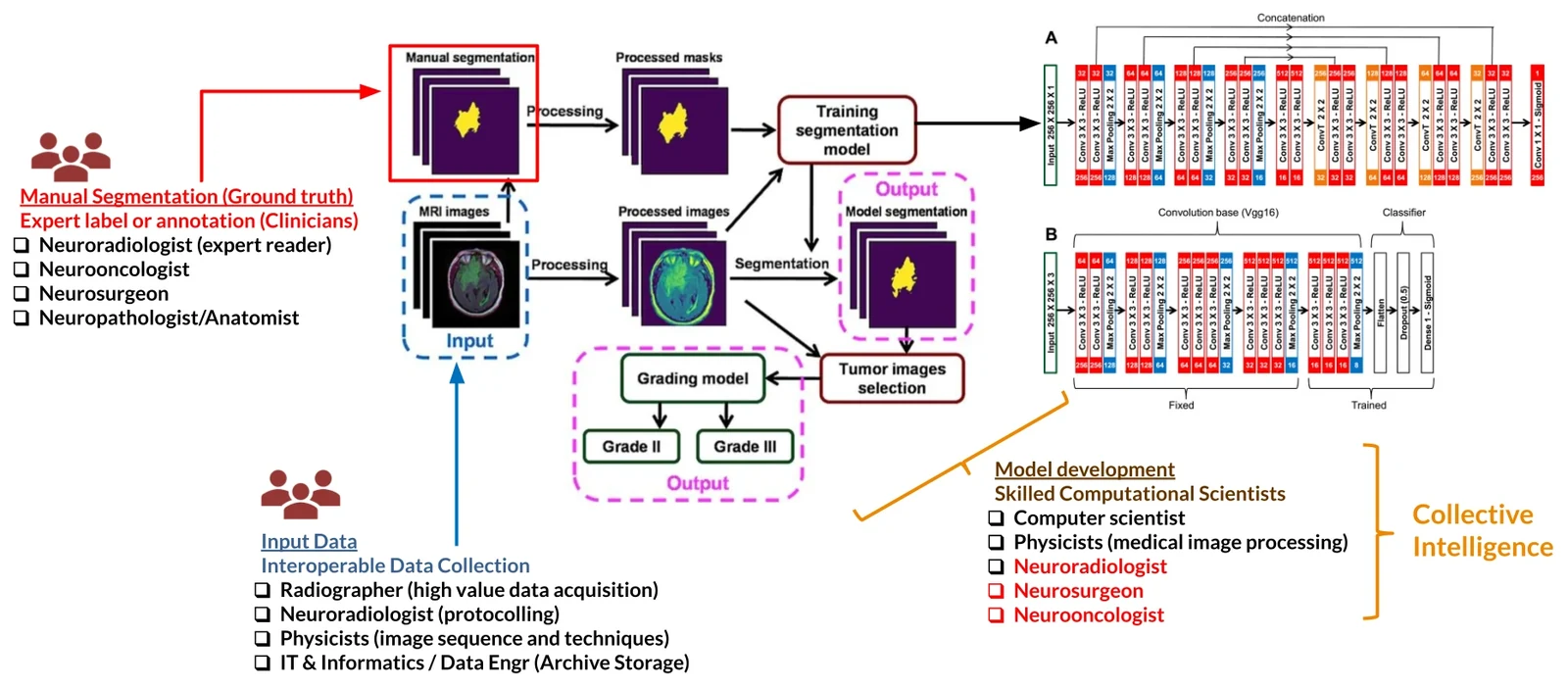
1 · Input data
Interoperable data collection
- Radiographer high value acquisition
- Neuroradiologist protocolling
- Physicists image sequence and techniques
- IT and informatics / data engineer archive storage
About
Sprint AI Training for African Medical Imaging Knowledge Translation (SPARK)
Sprint AI Training for African Medical Imaging Knowledge Translation (SPARK) is committed to empowering African data science communities and imaging researchers to develop deployable imaging diagnostic tools that can assist clinicians to provide high-value care and bridge the gap in the medical disparity between Africa and the rest of the world.
SPARK is one of the training platforms of the Consortium for Advancement of MRI Education and Research in Africa (CAMERA) offered through the Medical Artificial Intelligence (MAI) Lab at Crestview Radiology Ltd, Lagos, Nigeria and the Multimodal Imaging of Neurodegenerative Disease (MiND) Lab, McGill University, Montreal, Canada.
The SPARK program, endorsed by the Medical Image Computing and Computer Assisted Intervention (MICCAI) Society, represents a comprehensive training program aimed at building a community of experts in artificial intelligence (AI) for medical imaging across Africa.
The limited infrastructure and lack of skilled personnel are major barriers to implementing AI solutions for healthcare in resource-limited settings, particularly across Africa.
Vision
Our vision is to transform medical diagnostics in Africa by increasing local capacity in medical imaging with artificial intelligence (AI).
We believe that by training a critical mass of African clinicians, physicists, and data scientists, we can facilitate the development of deployable AI tools to improve the quality of healthcare in Africa.
Mission
Our mission is to provide case-based training on medical image analysis and the application of AI methods to diagnostic imaging to African data science communities and imaging researchers.
We are dedicated to inspiring local communities to develop home-grown medical solutions using AI and providing them with the tools and resources to succeed.
Objectives
Provide transferable research skills, including study design, execution, and dissemination.
Build an interdisciplinary capacity of highly qualified AI personnel across Africa.
Foster a collaborative culture for developing innovative medical solutions.
Contribute to global open-science efforts in AI imaging.
To achieve our mission, we provide a free hands-on training program that implements the RAD-AID, Teach-Try-Use approach and takes trainees through three learning blocks to successfully train-the-trainers and create the critical mass of AI imaging experts in Africa.
Block 1 · Workshop
The first block (Teach) is a virtual 10-week foundational course on medical imaging processing, analysis and fundamentals of computer programming.
Block 2 · Hackathon
The second block (Try) is a 1-week hybrid (in-person + virtual) hackathon across five or more African countries.
Block 3 · Grand challenge
The third (Use) block is a 10-week guided practicum on development and evaluation of an AI method for a specific use case.
SPARK uses a curriculum that is case-based and a train-the-trainer model to provide free access to hands-on skill development. This model adopts the RAD-AID Teach-Try-Use strategy, comprising foundational courses (Teach), a hybrid hackathon (Try), and a guided practicum (Use). This provides participants with theoretical knowledge, hands-on experience, and practical application skills.
SPARK Academy in deep learning and medical imaging rests on three pillars, each with a concrete outcome.
Pillar 1
Accelerate imaging informatics and AI competence
Pillar 2
Develop local AI tools for relevant imaging needs
Pillar 3
A collaborative network of AI labs and imaging clinics
Each SPARK Academy is aimed at a real-world use case and implements collective intelligence built around a networking space to advance AI capacity and rapid implementation in Africa.
Our first SPARK Academy, endorsed by the Medical Image Computing and Computer Assisted Intervention (MICCAI) Society, trained African clinicians and scientists to develop state-of-the-art AI methods for glioma brain tumor segmentation.
The first program brought together oncology, neurology and neurosurgery, radiology, medical physics, biomedical engineering and computer science residents and graduate students from across Africa who co-developed informed AI methods for segmentation of brain tumors into sub-regions on magnetic resonance imaging (MRI) scans.
1 · Input data
2 · Manual segmentation
3 · Model development
Together: collective intelligence
Two example teams. Each has a site director, program lead coordinators, a team supervisor, a clinician, a programmer and a researcher, alongside team members, and members from other countries.
Team members
Members from other countries
Across the network there are over 15 site directors overseeing SPARK physical sites, 46 team coordinators across Africa and South East Asia, and 25 technical support team members.
At SPARK, we believe that education and collaboration are key to advancing the field of medical imaging analysis and developing innovative solutions for medical diagnosis, treatment, and prevention.
We are committed to creating an inclusive and supportive learning environment that encourages growth and development for African data science communities and researchers.
Join us on this exciting journey and become a part of the SPARK community today. Together, we can make a positive impact on the future of healthcare in Africa.
Please feel free to send us an email to start a discussion. We would be happy to hear from you and explore potential opportunities for collaboration.
Contact us at info.camera.mri@gmail.com
Follow us
+1 514-398-1636